La Scala mel (dalla parola melody) è una scala di percezione dell’altezza (pitch) di un suono. È stata proposta da Stanley Smith Stevens, John Volkman e Edwin Newman nel 1937 nel Journal of the Acoustical Society of America.
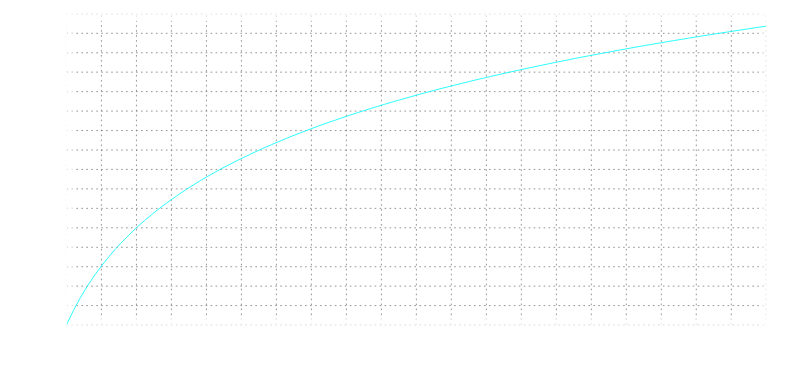
La scala mel è una scala di altezze giudicate dagli ascoltatori uguali in distanza l’una dall’altra. Il punto di riferimento tra questa scala e la normale misurazione della frequenza è definito equiparando un tono di 1000 Hz, 40 dB sopra la soglia dell’ascoltatore, con un’intonazione di 1000 mel. Al di sotto di circa 500 Hz le scale mel e hertz coincidono; al di sopra di ciò, gli intervalli sempre più grandi vengono giudicati dagli ascoltatori per produrre incrementi di intonazione uguali.
Di conseguenza, quattro ottave sulla scala hertz superiori a 500 Hz sono giudicate come comprendenti circa due ottave sulla scala mel.
If everyone in the world had perfect pitch, then the Mel scale would make perfect sense. Instead, some people have untrained ears and so when they went to try to measure how accurately human ears could detect relative pitch differences using an arbitrary linear scale, different people gave different answers and in different ranges. The Mel scale is sort of the average shittyness of how well a random human ear can guess relative pitch difference.
Using 1000 as a starting pitch, they had people guess proportions of 1000 that they feel the next pitch they hear is different from that starting pitch. Like they literally played two pitches and a listener might guess that one pitch had “twice as much pitch” as the other. Thats how they made this scale in a nutshell. In principle, If all the listeners were trained or had perfect pitch, then every major 2nd they were given to listen to would have yeilded the same answer, and the Mel scale would be perfectly linear in all ranges.
I’ll give an example of an arbitrary linear mapping to illustrate the idea:
Suppose the pitch of C4 was a 5, then let C5 be 6, C6 be 7 and so on. In this scale, C5 is 1 more unit of pitch than C4.
Voila. I have now converted diatonic pitches to a linear scale. If we then convert diatonic pitches to frequencies, we would then have that 5 → 261.63Hz, 6 → 523.25Hz, 7 → 1046.50Hz. With this scale we could calculate A3’s value to be (5 / 261.63Hz) * 220Hz = 4.204
This is what the Mel scale is doing to physical pitches in a basic sense. Except instead of just mapping octaves to integers, it maps frequency through a touchy feely I-Guess-This-Is-Right method that one of the studies roughly came out to the following logarithm.